Books & Literature
Explore first editions, manuscripts, and literary works that shaped Black intellectual and cultural discourse.

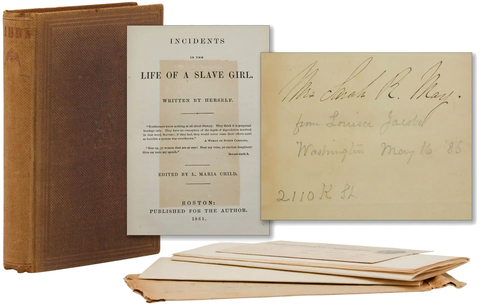
This first-edition copy of Incidents in the Life of a Slave Girl (Boston, 1861) is an exceptional presentation copy given by Harriet Jacobs’s daughter, Louisa Jacobs, to Sarah R. May, wife of abolitionist Rev. Samuel May Jr., in 1886. Bound in the publisher’s original light brown beaded cloth with gilt spine, this near-fine copy remains unrestored and is accompanied by extraordinary provenance: two period obituaries for Harriet Jacobs mounted within the book, and a fourteen-page holograph letter describing Jacobs’s 1897 funeral service, including a handwritten copy of the eulogy delivered by Rev. Francis James Grimké, a leading African American minister of the era. The letter, written by Sarah Earle to Samuel May, is the only known surviving eyewitness account of Jacobs’s funeral. The Mays were close friends and supporters of the Jacobs School, a Freedmen’s school founded in Alexandria, Virginia, in 1863 by Harriet and Louisa Jacobs to educate formerly enslaved Black children—a project that embodied Harriet’s belief that Black educators were essential for community empowerment.
Incidents in the Life of a Slave Girl stands as the most important slave narrative written by an African American woman. Whereas earlier narratives focused primarily on physical suffering and literacy, Jacobs broke new ground by centering her account on motherhood, sexual exploitation, and the unique horrors slavery inflicted on women—creating not only a vital historical document but also a foundational early work of Black feminist literature. This presentation copy is rare in original cloth, especially in such fine condition and with such extraordinary provenance linking Jacobs’s family to the abolitionist network and Black educational leadership. The accompanying funeral documentation preserves a critical, intimate moment of remembrance and adds unparalleled depth to the historical record.

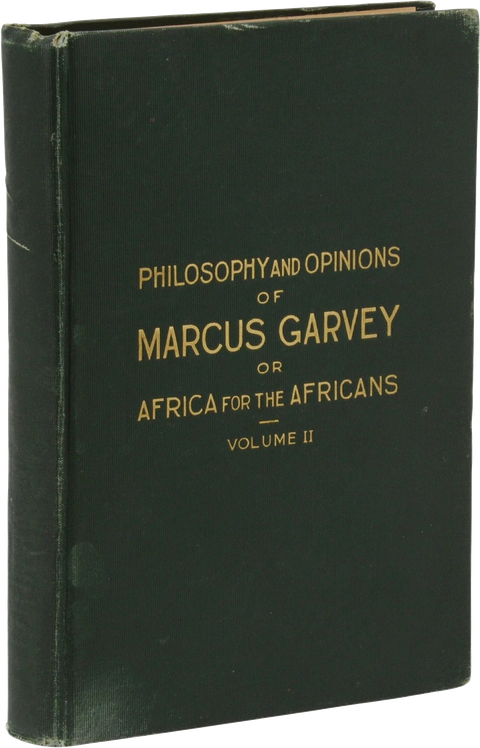
Philosophy and Opinions of Marcus Garvey (First Edition, Vol. 2, 1925) is a cornerstone of Pan-African and Black nationalist thought, presenting the collected writings, speeches, and editorials of Marcus Garvey as edited by Amy Jacques Garvey. Issued during Garvey’s pivotal years in the 1920s, Volume 2 expands on the themes introduced in the first volume—self-reliance, the imperative for global Black unity, critiques of colonialism, and the blueprint for the Universal Negro Improvement Association (UNIA). The text features Garvey’s reflections on his trial, imprisonment, and the obstacles faced building a worldwide movement for African diaspora liberation.
Volume 2 stands on its own as a document of immense historical and philosophical value, chronicling Garvey’s bold advocacies at his movement’s zenith. The work’s direct, urgent voice galvanized intellectual and popular Black resistance from the Harlem Renaissance to anti-colonial struggles worldwide. It remains a foundational resource for scholars, activists, and collectors of Black heritage. The scarcity of any first edition—especially a complete, original Volume 2—enhances its desirability, reflecting the grassroots challenges under which these books were printed and distributed, often funded by the UNIA community itself.

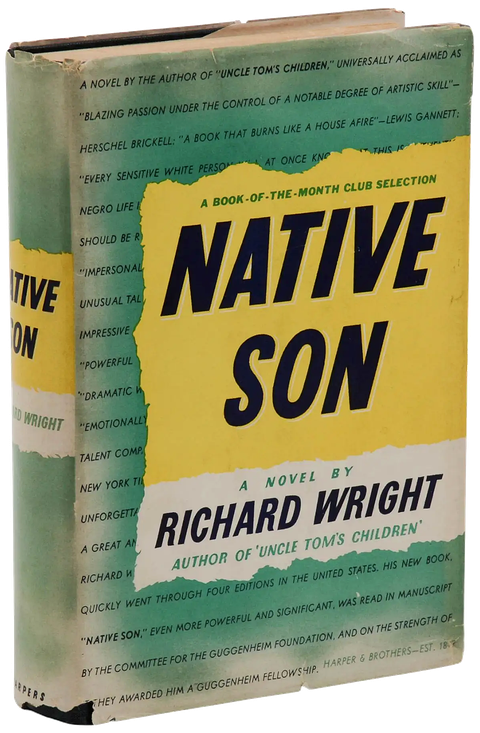
Native Son is Richard Wright’s explosive, era-defining novel of social realism and psychological anguish, first published in 1940. Set in 1930s Chicago, the story follows Bigger Thomas, a young Black man whose accidental killing of a white woman—and its aftermath—expose the racial, economic, and psychological forces shaping Black existence in America.The novel’s unflinching depiction of systemic racism, fear, anger, and the consequences of social oppression broke new ground in American literature. Wright’s prose balances the tension between protest and artistry, creating a work that is both a page-turning thriller and a searching moral inquiry.The book appeared in this iconic first edition with a bright dust jacket and quickly became a national bestseller, catalyzing debates and challenging both literary and social boundaries.
Upon publication, Native Son was selected by the Book-of-the-Month Club and sold a quarter of a million copies within months—a level of commercial and cultural impact unprecedented for a Black author. The novel’s raw honesty and its empathetic yet uncompromising portrayal of Bigger Thomas marked a turning point for African American literature and for national conversations about race, justice, and identity.Native Son inspired generations of writers and thinkers, opening a path for literature that explored Black identity with candor, agency, and literary force.

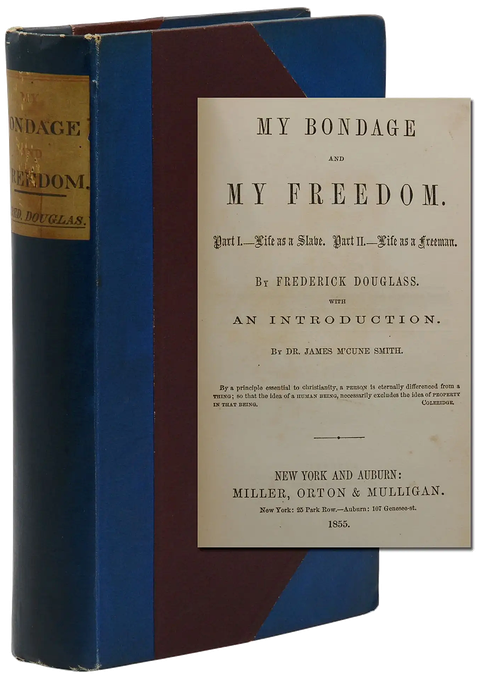
Frederick Douglass’s My Bondage and My Freedom is the landmark second autobiography of America’s most influential abolitionist and orator. First published in 1855, the work significantly expands upon Douglass’s earlier Narrative of the Life of Frederick Douglass (1845), offering a deeper and more nuanced account of his years in slavery, his path to emancipation, and his evolution as a thinker and activist.Distinguished by its preface from Dr. James McCune Smith and by Douglass’s own maturity and insight, the book provides detailed commentary on the moral, social, and political realities of mid-19th-century America. It reflects Douglass’s evolving views on race, freedom, and independence from white abolitionist oversight, offering a holistic perspective on both the horrors of slavery and the possibilities of African American self-determination.
My Bondage and My Freedom stands as one of the most important slave narratives of the 19th century and remains a cornerstone of African American literature and the abolitionist movement. Its publication marked Douglass’s emergence as an independent Black intellectual and activist, distinct from the control of white abolitionist organizations.The book’s literary depth, length, and political sophistication influenced both contemporary debates and later generations’ understanding of American slavery, resilience, and the pursuit of justice.

Popo and Fifina: Children of Haiti is a groundbreaking children’s novel published in 1932, co-authored by Harlem Renaissance luminaries Arna Bontemps and Langston Hughes and illustrated by pioneering Black artist E. Simms Campbell.This lyrical and gentle story follows the everyday adventures and family life of two young siblings, Popo and Fifina, growing up in a Haitian village. The book provides authentic and respectful representation at a time when Black children’s voices were rarely heard in American literature, making it both accessible and culturally significant for generations of young readers.
Popo and Fifina is widely recognized as the first mainstream, book-length children’s novel entirely created by African American writers and illustrator, published by a major press. The collaboration between Bontemps, Hughes, and Campbell marked a critical turning point in representation, bringing Black authorship and artistry into a national children’s book market that had long excluded such narratives.Its positive and nuanced portrait of Black childhood and Haitian culture challenged prevailing stereotypes and laid the groundwork for later multicultural children’s literature, setting a precedent for authentic storytelling for young readers of color.

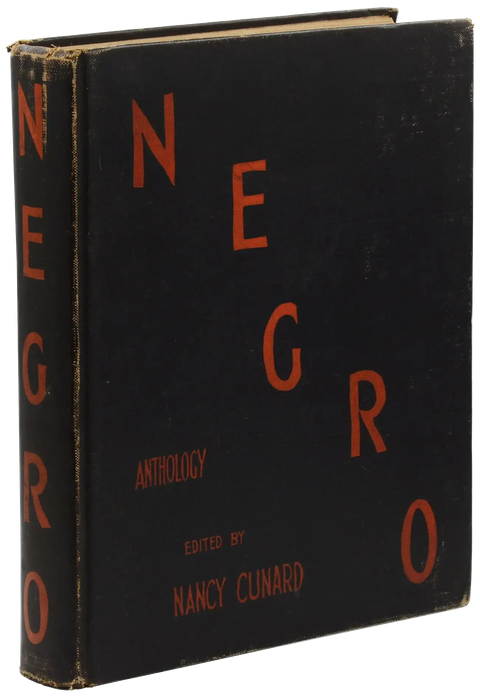
Published in London by Wishart & Co. in 1934, Negro: Anthology is a monumental 856-page volume edited by Nancy Cunard, compiling essays, poetry, history, art, sociology, and political writings from over 150 international contributors.The anthology features major Harlem Renaissance figures such as Langston Hughes, Zora Neale Hurston, W. E. B. Du Bois, Arthur Schomburg, and Countee Cullen, alongside voices from the Caribbean, Africa, Europe, and beyond. Boldly bound in black cloth with red stamped titling and lavishly illustrated, the book documents the breadth of Black achievement, cultural identity, and political struggle across the diaspora during a period of global crisis.
Negro: Anthology is one of the most ambitious and wide-ranging compilations of Black life and thought from the early twentieth century, breaking barriers as both a literary and political document. Nancy Cunard, a British heiress turned radical, envisioned the anthology as a weapon against racism, imperialism, and fascism.The work’s intellectual rigor, scope, and commitment to the Black experience earned it a reputation as a “secular Bible of African culture” and established a model for later anthologies of global Black literature. Many copies were lost when a warehouse holding unsold stock was bombed during the Blitz, enhancing the rarity and mystique of the first edition.

This is the rare first edition of W. E. B. Du Bois’s influential collection, The Souls of Black Folk, published in 1903 by A. C. McClurg & Co., New York. Bound in original black cloth, ruled in blind and lettered in gilt, the book presents fourteen essays exploring the experience, humanity, and challenges faced by African Americans at the dawn of the twentieth century.Du Bois’s writing blends personal memoir, historical analysis, sociological insight, and literary artistry. Each chapter opens with two epigraphs—one from a white poet and one from a Black spiritual—highlighting both the cultural parity and shared artistry of Black and white America.
The Souls of Black Folk is a cornerstone of African American literature and social thought. Du Bois introduced the concepts of “double consciousness” and “the veil”, describing the psychological and social challenges of being both Black and American. The book offered a vision for Black identity rooted in proud endurance and cultural strength.Du Bois’s famous assertion that “the problem of the Twentieth Century is the problem of the color line” shaped intellectual and political discourse and influenced generations of writers, activists, and thinkers, leaving a lasting impact on civil rights, social theory, and creative expression.

Narrative of the Life of Frederick Douglass is the landmark first edition of Frederick Douglass’s foundational autobiography, published in Boston at the Anti-Slavery Office in 1845. This first printing consists of xvi, 125 pages, bound in the original brown cloth, stamped in blind with gilt titles on the upper board, and often including a frontispiece portrait of Douglass.The book vividly recounts Douglass’s life from enslavement in Maryland to self-emancipation, intellectual awakening, and his pivotal role as an abolitionist leader. The text includes an introduction by William Lloyd Garrison and a letter from Wendell Phillips, lending credibility and authority to Douglass as both author and activist. The narrative provides an unprecedented, first-person account of slavery’s brutality and the enduring fight for freedom.
Recognized as one of the most important works in American and African American literature, Douglass’s Narrative transformed perceptions of slavery and fueled the abolitionist movement in the United States and abroad. Within five years, it sold thousands of copies and was translated into multiple languages. The work legitimized Douglass as a global advocate for emancipation and equal rights and remains a powerful document of resistance, hope, and resilience.

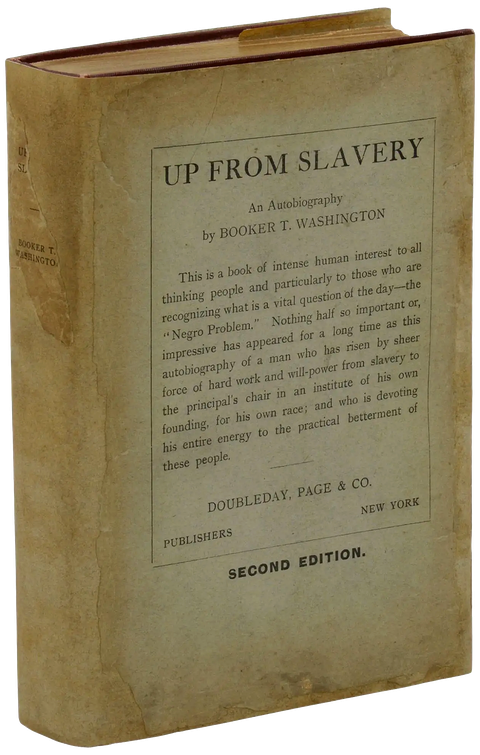
Up From Slavery: An Autobiography is Booker T. Washington’s seminal 1901 memoir, published by Doubleday, Page and Company. This first edition, first issue comes in the original dust jacket with the “Second Edition” plug at the bottom of the front panel.The book traces Washington’s journey from enslavement in Virginia, through emancipation and pursuit of education at Hampton Institute, to his rise as a nationally recognized educational leader and founder of Tuskegee Institute. This edition features burgundy gilt-stamped cloth binding, top edge gilt, and a photogravure frontispiece. Copies in the original dust jacket are extremely rare and highly prized by collectors.
Washington’s autobiography is one of the most celebrated and widely read African American literary works, providing firsthand insight into the challenges and strategies of Black advancement in post-Civil War America. Its themes of self-reliance, practical education, and social uplift influenced generations, shaping race relations and American educational theory for decades.Up From Slavery also features Washington’s famous 1895 Atlanta Compromise speech, cementing his status as one of the era’s most influential Black voices.

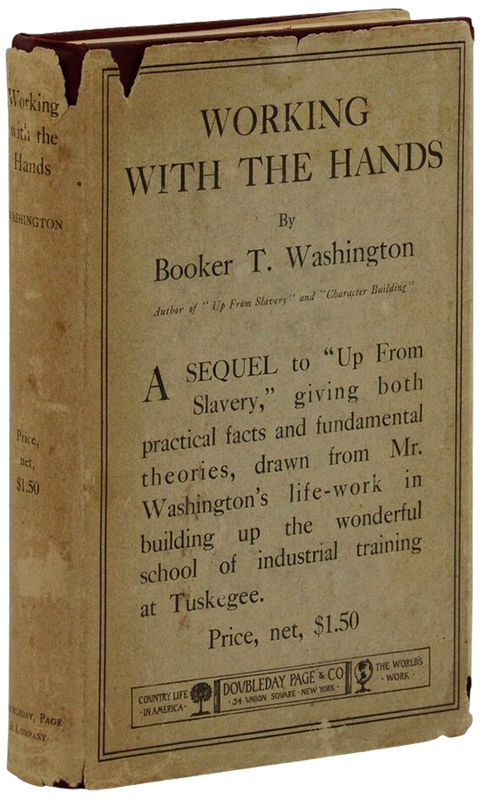
Working with the Hands is a 1904 nonfiction work by Booker T. Washington, published as a sequel to his celebrated autobiography, Up from Slavery. This first edition features original maroon cloth binding and includes 32 full-page photographic plates by Frances Benjamin Johnston, depicting scenes from Tuskegee Institute.The book documents Washington’s experiences and philosophies regarding industrial training for African Americans, emphasizing the integration of manual labor, practical education, and character development. Combining personal narrative, educational theory, and reporting on student life, it presents a vivid portrayal of Tuskegee’s transformative impact on Black men and women in the early twentieth century.
Published during an era of harsh racial realities in the United States, Working with the Hands captures Washington’s efforts to build a model of Black educational empowerment in the Deep South. The book outlines a curriculum for industrial and academic achievement, while highlighting the expansion to include female students, notably through his wife Margaret Murray Washington’s essay, “Helping the Mothers.”Washington’s work was both highly influential and controversial, sparking debates on Black advancement, self-reliance, practical skills, and social equality. This first edition remains a landmark artifact, standing alongside his other major works as essential documentation of African American education, culture, and progress.