Resources:
Curated African American artifacts with historical context.
Showing 1-12 of 85 resources

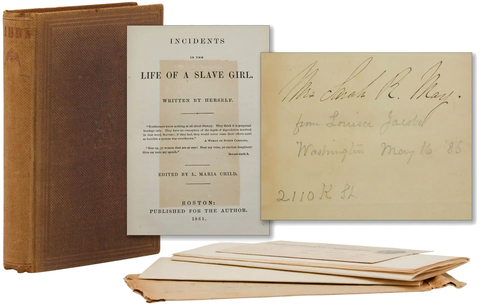
This first-edition copy of Incidents in the Life of a Slave Girl (Boston, 1861) is an exceptional presentation copy given by Harriet Jacobs’s daughter, Louisa Jacobs, to Sarah R. May, wife of abolitionist Rev. Samuel May Jr., in 1886. Bound in the publisher’s original light brown beaded cloth with gilt spine, this near-fine copy remains unrestored and is accompanied by extraordinary provenance: two period obituaries for Harriet Jacobs mounted within the book, and a fourteen-page holograph letter describing Jacobs’s 1897 funeral service, including a handwritten copy of the eulogy delivered by Rev. Francis James Grimké, a leading African American minister of the era. The letter, written by Sarah Earle to Samuel May, is the only known surviving eyewitness account of Jacobs’s funeral. The Mays were close friends and supporters of the Jacobs School, a Freedmen’s school founded in Alexandria, Virginia, in 1863 by Harriet and Louisa Jacobs to educate formerly enslaved Black children—a project that embodied Harriet’s belief that Black educators were essential for community empowerment.
Incidents in the Life of a Slave Girl stands as the most important slave narrative written by an African American woman. Whereas earlier narratives focused primarily on physical suffering and literacy, Jacobs broke new ground by centering her account on motherhood, sexual exploitation, and the unique horrors slavery inflicted on women—creating not only a vital historical document but also a foundational early work of Black feminist literature. This presentation copy is rare in original cloth, especially in such fine condition and with such extraordinary provenance linking Jacobs’s family to the abolitionist network and Black educational leadership. The accompanying funeral documentation preserves a critical, intimate moment of remembrance and adds unparalleled depth to the historical record.

This rare original typed letter signed by Malcolm X ("Malcolm X"), dated February 2, 1965, on his personal New York letterhead (10 ⅜" x 7 ¼"), is addressed to Miss Ellenie R. Ash of Amsden, Ohio. Written in crisp type with Malcolm X’s bold red script signature and “Malcolm X” notation at the head, the letter responds thoughtfully to a correspondent, addressing themes of honesty, race, slavery’s lasting scars, and his evolving views on religion and Black self-determination. The single-page document shows typical mailing folds and light aging, with clear, legible text and a strong signature.
Written less than three weeks before his assassination on February 21, 1965, this letter captures Malcolm X during a transformative period — shortly after his break with the Nation of Islam and his pilgrimage to Mecca. In it, he articulates nuanced ideas on race, the psychological impact of slavery, and the true meaning of Islam, offering a direct window into his philosophy as he sought to unify and empower Black communities. As one of the most important voices of the 20th century, Malcolm X’s signed correspondence from this critical window is exceptionally scarce and historically vital.

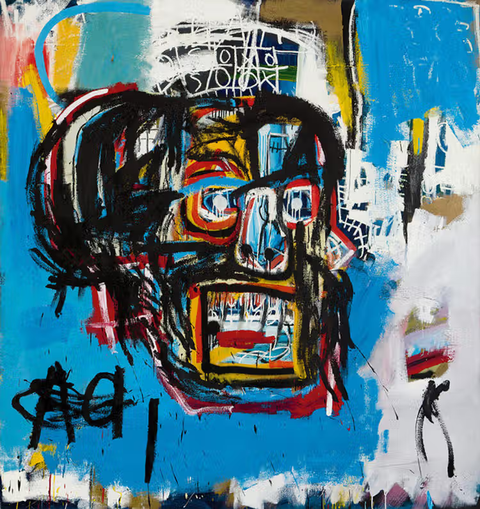
"Untitled" (1982) by Jean-Michel Basquiat is a monumental neo-expressionist painting featuring a raw, mask-like skull rendered in vivid colors against an electric blue field. Created at the age of 21, this iconic work captures Basquiat’s fusion of street art, African heritage, and contemporary social commentary. Its energetic brushwork and layered symbolism reflect Basquiat's interest in urban experience, personal identity, and themes of life and mortality. Deeply autobiographical, the skull may function as a self-portrait, channeling Basquiat’s struggles with race, fame, and vulnerability.
The painting is widely regarded as Basquiat’s masterpiece and a touchstone of postwar art. When it sold for $110.5 million at Sotheby’s in 2017, it set a world record for a work by a Black artist and made Basquiat the youngest artist in history to cross the $100 million mark at auction. "Untitled" has come to represent not only the apex of Basquiat’s practice, but also the soaring global recognition of Black brilliance in contemporary art. Its innovative style and message continue to influence generations of artists and collectors.

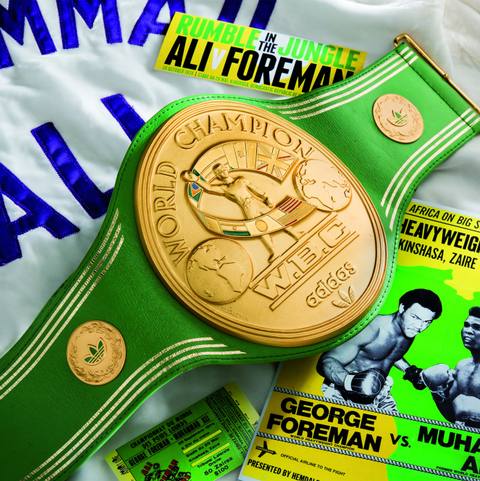
This is the original WBC Heavyweight Championship belt awarded to Muhammad Ali following his legendary victory over George Foreman in the “Rumble in the Jungle,” Zaire, October 30, 1974. Crafted with green leather, gold-hued metalwork, and adorned with enamel international flags, this belt served as the ultimate symbol of boxing supremacy for Ali's second reign as champion. The championship bout restored Ali’s undisputed status, reversing years of exile and adversity that followed his refusal to be drafted into the Vietnam War. The belt is closely associated with numerous photos from Ali’s historic defenses, and, alongside event tickets and artifact provenance, it carries an unmatched legacy of athletic and cultural impact.
This belt is tangible evidence of one of the most famous matches and comebacks in sports history, marking Ali’s triumphant return to the pinnacle of the fight world. “The Rumble in the Jungle” transcended boxing, symbolizing resilience, intelligence, and societal progress amid a backdrop of global racial and political tensions. Ali’s improbable victory over the formidable Foreman remains a defining episode of twentieth-century sport, with this belt cementing his legacy as not just a champion, but a transformative figure in American and world history.

Once Upon a Time in Shaolin is the rarest hip-hop album ever created, serving simultaneously as an art object, a musical statement, and a high-profile collectible. Produced in secrecy from 2006 to 2013, the double album was pressed as a single copy, enclosed in an ornate nickel-silver box sealed with the Wu-Tang Clan’s wax insignia, and accompanied by leather-bound liner notes. Its creation sought to counter the devaluation of music in the digital era by restoring it to the realm of fine art. The album sold in 2015 for $2 million to Martin Shkreli, was later seized by the U.S. government following his conviction, and resold in 2021 for a reported $4 million to PleasrDAO, a digital art collective. Legal restrictions prohibit its commercial release until 2103, amplifying its mystique and cultural legacy.
This album stands as the ultimate “Black Grail” of hip-hop, embodying unprecedented scarcity, record-breaking auction value, cultural controversy, and a narrative that blurs the boundaries between music, art, and law. The story of its secret recording, high-profile ownership, and deliberate exclusivity represents a bold redefinition of how Black art and intellectual property can be valued, protected, and celebrated. Wu-Tang’s vision continues to shape conversations around access, collecting, copyright, and the meaning of music ownership as a singular artistic experience.

The 1949 Bowman Jackie Robinson #50 is a cornerstone postwar baseball card, featuring a vibrant, color-enhanced portrait of Robinson in his Brooklyn Dodgers uniform against a bold red background. One of the earliest mainstream gum cards to depict the man who broke Major League Baseball’s color barrier in 1947, it showcases Robinson’s charismatic smile and signature “Dodgers” script in blue across the chest. As part of Bowman’s first color-enhanced baseball set, the card captures the visual excitement of the era’s trading card renaissance while documenting a pivotal figure at the height of his on-field dominance.
This card immortalizes Jackie Robinson during his 1949 MVP season, just two years after he shattered baseball’s racial barrier and ignited the modern civil rights movement in sports. As one of the first widely distributed mainstream cards of Robinson, it symbolizes both athletic excellence and profound social transformation—marking the moment Black excellence became visible and collectible in American homes. It stands as a powerful artifact bridging sports memorabilia and cultural history, representing the integration of America’s pastime and the beginning of a new era for Black athletes in the national spotlight.

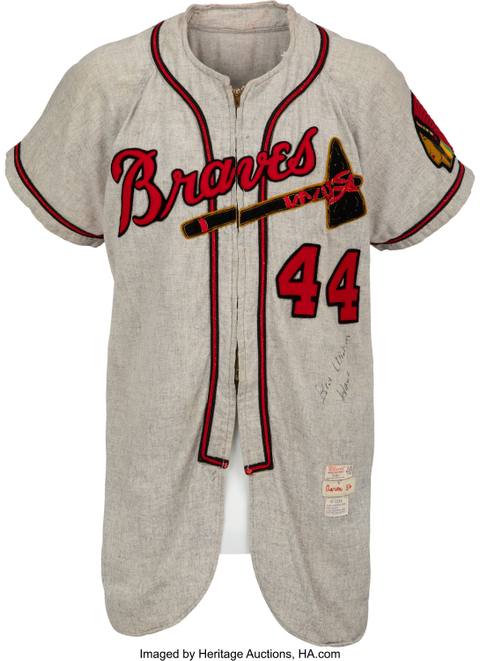
Aaron’s first Topps card greets collectors with a colorful horizontal format that stands out among its peers. It features a smiling portrait alongside an action image of Aaron at bat, reflecting both his positivity and unwavering focus. The 1954 Topps set was innovative for its bold colors and dynamic layouts, with the Aaron rookie being one of the most celebrated in the lineup.
Hank Aaron’s journey as a trailblazing slugger included breaking Babe Ruth’s career home run record, becoming a symbol of perseverance under intense public scrutiny and racial animus. Aaron’s role in the civil rights movement and his influence beyond baseball elevated his rookie card into a cultural artifact, marking the ascent of a player who would become a legend both on and off the field.

Resurrection (1966) is a square acrylic and graphite on canvas by Alma Thomas, composed of concentric yet irregular rings of vivid color set against a bright white ground. Short, mosaic‑like strokes of yellow, red, blue, green, and violet form pulsing bands that radiate outward, creating the sensation of a glowing sunburst or rippling wave of light. The layered “Alma lines”—Thomas’s signature dabs of color—give the painting a dynamic, almost musical rhythm, while the central yellow forms suggest a luminous core that visually expands beyond the canvas edge. Completed the year she retired from teaching, the work reflects Thomas’s late-career embrace of pure abstraction and her fascination with nature, light, and spiritual transformation.
Resurrection is celebrated as a breakthrough work in Thomas’s mature style and is often cited as one of her earliest and most focused concentric-circle compositions. The painting crystallizes her shift from representational scenes to optical, color‑driven abstraction, turning observations of gardens, sunlight, and seasons into a powerful, nonfigurative meditation on renewal. In 2015, the work was acquired for the White House Collection and installed in the Old Family Dining Room during the Obama administration, making Thomas the first African American woman artist represented in the permanent White House art collection. Its placement in a central ceremonial space signaled a deliberate re-centering of Black women’s creativity within the visual narrative of American history and state power.

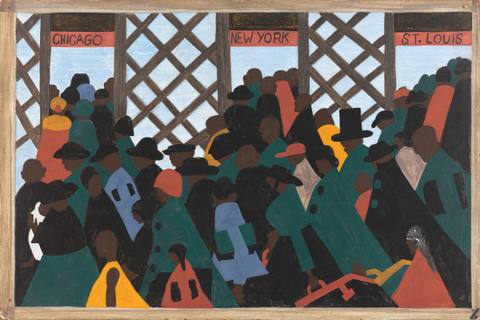
Jacob Lawrence’s “The Migration Series” consists of 60 vividly painted panels completed in 1941, documenting the mass exodus of African Americans from the rural South to the urban North between the 1910s and 1920s. Each panel combines modernist composition, striking colors, and concise captions, weaving together a compelling story of hope, adversity, and collective transformation. Lawrence researched and painted the series as a unified project, ensuring both narrative and visual cohesion.
Lawrence's series is a touchstone for Black heritage preservation, embodying the resilience, ingenuity, and determination of African American migrants facing racial oppression. It sparked nationwide recognition as the first work by a Black artist purchased by MoMA, catalyzing conversations about racial equality and social justice that remain relevant today. "The Migration Series" continues to educate and inspire, reminding viewers that movement itself, despite struggle, can carry opportunity, power, and beauty.

This engaging, color-rich card debuted as part of the seminal 1948 Leaf set and features Jackie Robinson in his Brooklyn Dodgers uniform, rendered with bold artwork and vivid primary colors that make it one of the most visually striking cards of the era. The Robinson rookie card is slightly oversized compared to standard issues, carrying his name across the bottom with a sense of optimism and defiance. It was printed in limited runs with notable centering and coloration variations, making high-grade copies extremely elusive for collectors.
Jackie Robinson’s appearance on this card represents one of the first mainstream trading cards designed for an African American athlete, coinciding with his historic 1947 MLB debut. Robinson’s presence on the field shattered baseball’s color barrier and accelerated integration in professional sports. The card stands as a testament to the role of sports in America’s social progress and the enduring courage of Robinson, whose legacy stretches far beyond the diamond.

"Past Times" by Kerry James Marshall is a monumental acrylic and collage painting portraying a Black family enjoying leisure by a lake, boating, golfing, and picnicking in a sprawling urban park. Completed in 1997, the work upends the Western art tradition by representing Black subjects in idyllic, upper-class settings commonly found in canonical paintings like Seurat’s "Sunday Afternoon on the Island of La Grande Jatte." Mixing references from Renaissance painting to Black folk art, Marshall combines a deep knowledge of art history with contemporary Black experience, using vibrant color, complex composition, and subtle symbolism to challenge stereotypes and expand the possibilities for Black representation.
"Past Times" is a pivotal work in the canon of contemporary art and a milestone for Black artists, blending the personal, the historic, and the universal. When Sean Combs purchased it for $21.1 million at Sotheby’s in 2018, the painting set a world record for a living Black artist, catapulting Marshall onto the global stage. The work has become an enduring symbol of the push for equity and presence in art history, as well as a powerful example of how the Black experience can reshape iconic themes of beauty, leisure, and community.

The “Men of Color, To Arms! Now or Never!” broadside is one of the most powerful recruitment posters produced during the American Civil War. Printed in Philadelphia in 1863, the poster called upon African American men to enlist in the Union Army following the issuance of the Emancipation Proclamation earlier that year. Written in bold, urgent language, the broadside appeals directly to Black men to seize what it describes as their “golden moment” to fight for liberty, citizenship, and the future of their race. The document emphasizes the opportunity for formerly enslaved and free Black men to prove their bravery and patriotism by joining the struggle against slavery. Its dramatic typography and powerful rhetoric made it one of the most compelling recruitment appeals of the Civil War era.
The broadside reflects the historic moment when African Americans were officially allowed to enlist in the Union Army, leading to the creation of the United States Colored Troops (USCT). More than 180,000 Black soldiers ultimately served in the Union forces, playing a decisive role in the Union’s victory and the eventual abolition of slavery. Frederick Douglass was one of the most influential advocates encouraging Black men to enlist, believing that military service would strengthen the claim to full citizenship and equality. Two of Douglass’s sons, Lewis Douglass and Charles Douglass, were among the first to enlist in the famous 54th Massachusetts Infantry Regiment. Recruitment broadsides like this one helped mobilize Black communities across the North and became powerful symbols of the fight for freedom and civil rights.