Sports Cards
Find rookie cards and sports memorabilia celebrating Black athletic pioneers and legends.

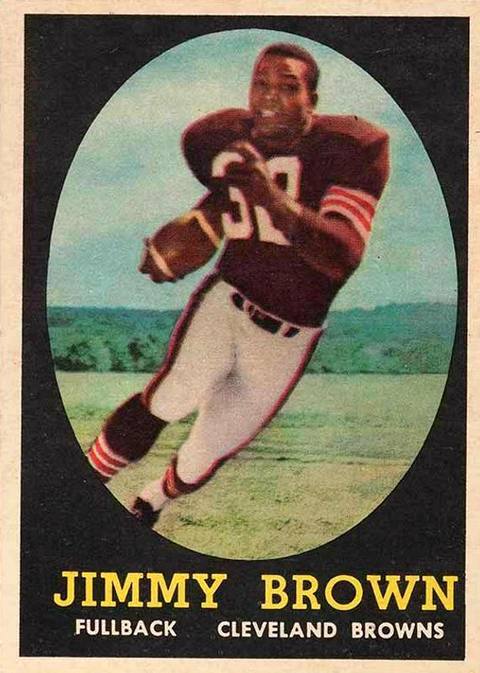
The 1958 Topps Jim Brown Rookie Card #62 captures the Cleveland Browns’ powerhouse running back in his second NFL season, bursting through an oval portrait against a pastoral green field backdrop. Rendered in rich, saturated colors with a bold black border and gold “JIMMY BROWN – FULLBACK – CLEVELAND BROWNS” lettering, this card exemplifies the 1958 Topps football set’s innovative design: the first time Topps placed players in natural outdoor scenes within distinctive team-colored ovals. As one of the cornerstone cards of the 132-card set, it stands as the premier rookie card from the era’s most dominant running back.
This is the only recognized rookie card of Jim Brown, widely considered the greatest running back in NFL history and a foundational figure in Black athletic excellence. Issued during the early years of integrated professional football, the card immortalizes Brown at the outset of his legendary career — where he would go on to dominate the league, set rushing records that stood for decades, and embody raw power, speed, and unbreakable will. For collectors, it ranks among the “Mount Rushmore” of football cards, prized for both its on-card imagery and its representation of a transformative Black superstar who elevated the sport’s cultural impact.

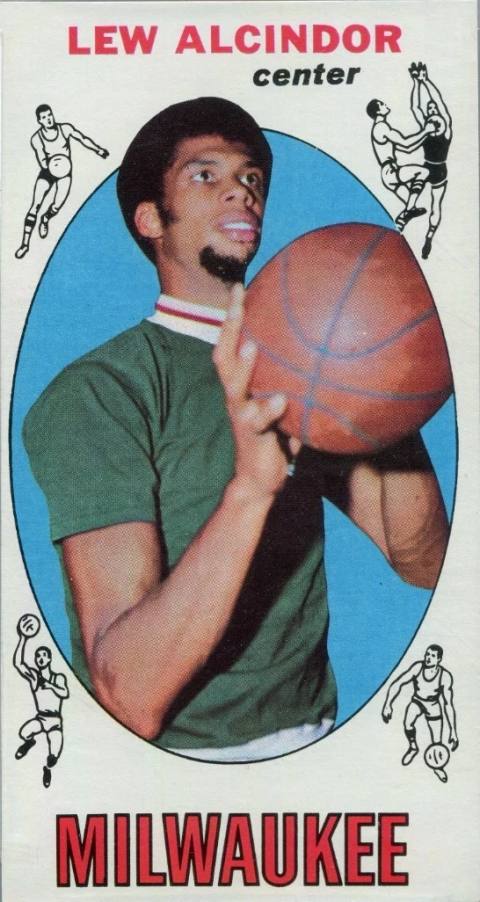
The 1969 Topps Lew Alcindor Rookie Card #25 presents the 7'2" UCLA phenom in a dynamic shooting pose, wearing a green Milwaukee Bucks practice jersey with red and white trim. Set against a bold blue oval background, the card is framed by four black-and-white action illustrations in the white borders and features striking red lettering for “LEW ALCINDOR – center” at the top and “MILWAUKEE” at the bottom. As part of Topps’ iconic “Tall Boys” design — measuring approximately 2½" x 4⅞" — this oversized card captures Alcindor (before he became Kareem Abdul-Jabbar) during his actual rookie NBA season with the Milwaukee Bucks.
This is the only official rookie card of one of the greatest basketball players in NBA history. Issued in 1969 during Lew Alcindor’s dominant rookie campaign (where he immediately won Rookie of the Year and helped transform the Bucks into contenders), it stands as the flagship card of the 99-card 1969-70 Topps basketball set. For collectors, it represents the arrival of a transcendent talent whose skyhook, longevity, and record-breaking scoring would redefine the center position and the sport itself. It remains one of the most sought-after basketball cards of the 20th century.

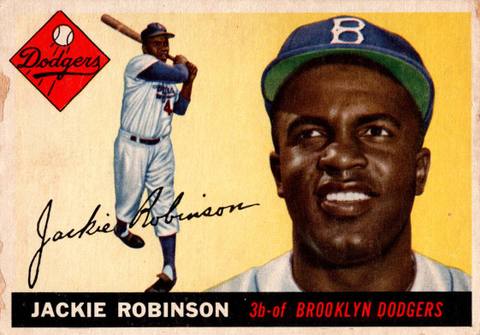
The 1955 Topps Jackie Robinson #50 presents the Brooklyn Dodgers legend in a confident, smiling close-up portrait against a bright yellow background. The card features Topps’ iconic 1955 horizontal design: a large player photo on the right, team logo (Dodgers in a red diamond) in the upper left, facsimile autograph, and a smaller action photo in the lower left showing Robinson in mid-swing. Printed in vivid colors with clean typography, this card captures Robinson during his prime years with the Dodgers, just eight seasons after he broke Major League Baseball’s color barrier.
This is one of the most iconic postwar cards of Jackie Robinson, the man who forever changed American sports and society as the first Black player in the modern Major Leagues. Issued during the 1955 season — when the Dodgers won the World Series — it stands as a premier card from the landmark 1955 Topps set. For collectors, it represents both athletic excellence and a pivotal moment in civil rights history, symbolizing Robinson’s grace under pressure, competitive fire, and lasting impact on baseball and beyond.

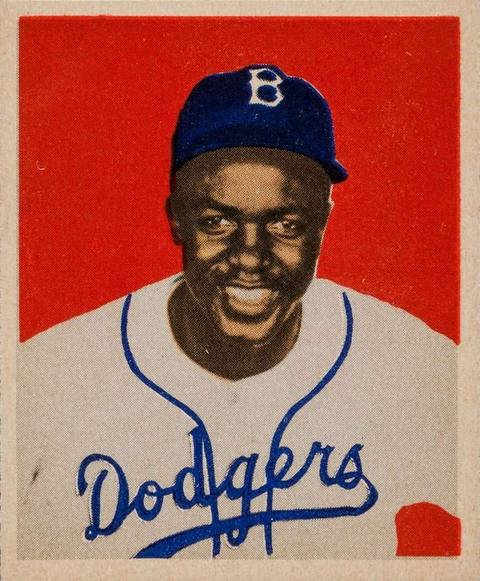
The 1949 Bowman Jackie Robinson #50 is a cornerstone postwar baseball card, featuring a vibrant, color-enhanced portrait of Robinson in his Brooklyn Dodgers uniform against a bold red background. One of the earliest mainstream gum cards to depict the man who broke Major League Baseball’s color barrier in 1947, it showcases Robinson’s charismatic smile and signature “Dodgers” script in blue across the chest. As part of Bowman’s first color-enhanced baseball set, the card captures the visual excitement of the era’s trading card renaissance while documenting a pivotal figure at the height of his on-field dominance.
This card immortalizes Jackie Robinson during his 1949 MVP season, just two years after he shattered baseball’s racial barrier and ignited the modern civil rights movement in sports. As one of the first widely distributed mainstream cards of Robinson, it symbolizes both athletic excellence and profound social transformation—marking the moment Black excellence became visible and collectible in American homes. It stands as a powerful artifact bridging sports memorabilia and cultural history, representing the integration of America’s pastime and the beginning of a new era for Black athletes in the national spotlight.

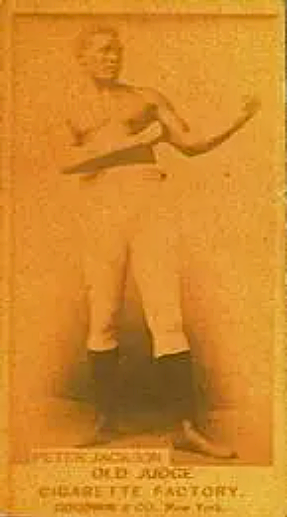
This card is considered the rookie card of Peter Jackson, a pioneering Black heavyweight boxer often referred to as "The Black Prince." It originates from the N174 Gypsy Queen Old Judge Cigarettes series, produced by Goodwin & Co. in the late 1880s. While some catalogs note 1887 as the production year, several reputable hobby guides and auction listings cite 1888, reflecting common discrepancies in the dating of pre-1900 tobacco cards. The card was issued soon after Jackson's arrival in America and is admired for its antique photographic style and fragile cardboard stock. Each card is unnumbered, featuring a sepia-tone image of Jackson posed in classic boxing attire. The meticulous detail captured by the old photographic process gives each specimen a unique vintage elegance. Only a handful of authenticated copies are known to exist, making this one of the true grails of 19th-century sports memorabilia.
Peter Jackson was one of the finest boxers of his era, a fighter whose technical prowess and resilience transcended racial barriers at the height of the color line in boxing. Jackson arrived in America in 1888 and quickly claimed the World Colored Heavyweight Championship, but was denied the opportunity to challenge for the official World Heavyweight Title, most notably by John L. Sullivan who refused to fight Black contenders. Jackson's reputation was legendary among his peers, with contemporary champions openly admiring his skill and cunning. His exclusion from the world title is considered one of the most profound injustices in sports history. This card stands as one of the earliest mass-produced images of a Black athlete and a powerful reminder of both the brilliance and struggles faced by trailblazers in American sport.

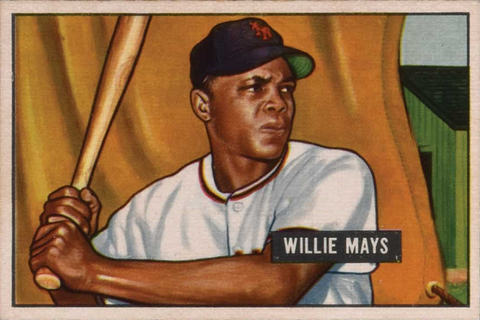
The 1951 Bowman features Willie Mays in the classic pose of youthful anticipation, set against a watercolor backdrop depicting a baseball field. The artwork is timeless, capturing Mays as a rising star with a seriousness and humility that reflected his early career. Bowman used high-quality card stock, and the image’s clarity stands in stark contrast to many early postwar issues. It remains the only recognized rookie card of “The Say Hey Kid,” arguably the most complete player in MLB history.
Willie Mays was a transformative figure whose career redefined the standards for athleticism, grace, and versatility in baseball. He arrived as a rookie in 1951, winning Rookie of the Year despite a slow start. His career stats and impact as a center fielder helped shape not only the game but also racial perceptions in sports. The 1951 Bowman marks Mays’s first appearance in the mainstream trading card arena, symbolizing his ascension and the dawn of a more inclusive era for Black athletes.

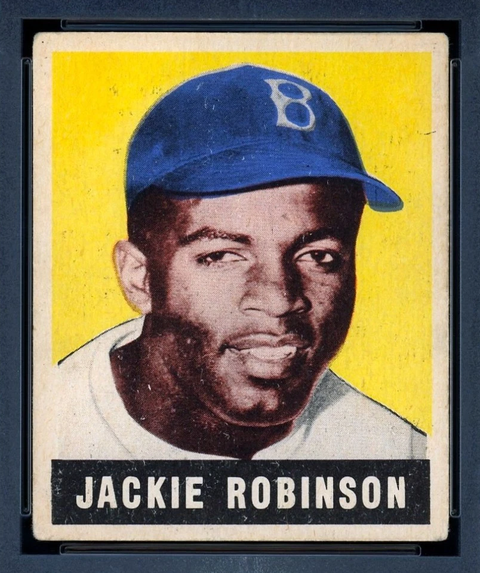
This engaging, color-rich card debuted as part of the seminal 1948 Leaf set and features Jackie Robinson in his Brooklyn Dodgers uniform, rendered with bold artwork and vivid primary colors that make it one of the most visually striking cards of the era. The Robinson rookie card is slightly oversized compared to standard issues, carrying his name across the bottom with a sense of optimism and defiance. It was printed in limited runs with notable centering and coloration variations, making high-grade copies extremely elusive for collectors.
Jackie Robinson’s appearance on this card represents one of the first mainstream trading cards designed for an African American athlete, coinciding with his historic 1947 MLB debut. Robinson’s presence on the field shattered baseball’s color barrier and accelerated integration in professional sports. The card stands as a testament to the role of sports in America’s social progress and the enduring courage of Robinson, whose legacy stretches far beyond the diamond.

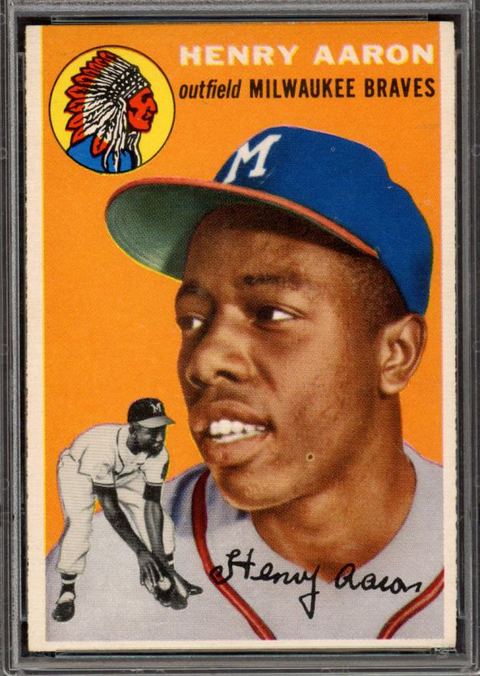
Aaron’s first Topps card greets collectors with a colorful horizontal format that stands out among its peers. It features a smiling portrait alongside an action image of Aaron at bat, reflecting both his positivity and unwavering focus. The 1954 Topps set was innovative for its bold colors and dynamic layouts, with the Aaron rookie being one of the most celebrated in the lineup.
Hank Aaron’s journey as a trailblazing slugger included breaking Babe Ruth’s career home run record, becoming a symbol of perseverance under intense public scrutiny and racial animus. Aaron’s role in the civil rights movement and his influence beyond baseball elevated his rookie card into a cultural artifact, marking the ascent of a player who would become a legend both on and off the field.

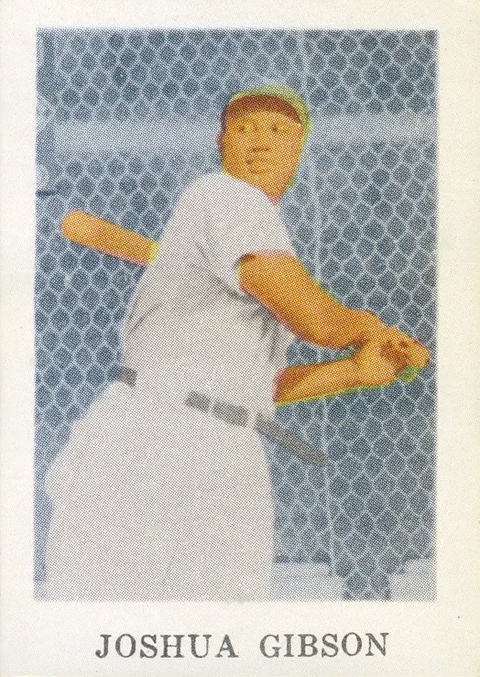
This card features the legendary Negro Leagues catcher, Josh Gibson, and was issued in Puerto Rico three years after his death as part of the 1950-51 Toleteros set. The card’s vivid design presents Gibson in full color as he was lauded in Puerto Rican baseball during his time playing winter ball. It stands as the only widely recognized standard trading card of Josh Gibson ever produced, with its existence confirmed only within the last two decades.
Josh Gibson is considered by historians and fans to be one of the greatest power hitters and catchers in baseball history. He was denied entry into Major League Baseball due to segregation, but his dominance in the Negro Leagues made him a legend whose true feats are often compared to Babe Ruth’s. His tragic death at age 35, just months before Jackie Robinson broke baseball’s color barrier, makes his absence from the majors symbolic of the era’s racial injustice. The Toleteros card was created as a posthumous tribute, as Gibson was a huge star in Puerto Rico, and is a key artifact for both Black sporting history and baseball as a whole. Its issuance outside the US exemplifies the international reverence for his legacy and the scarcity of Negro League collectibles.

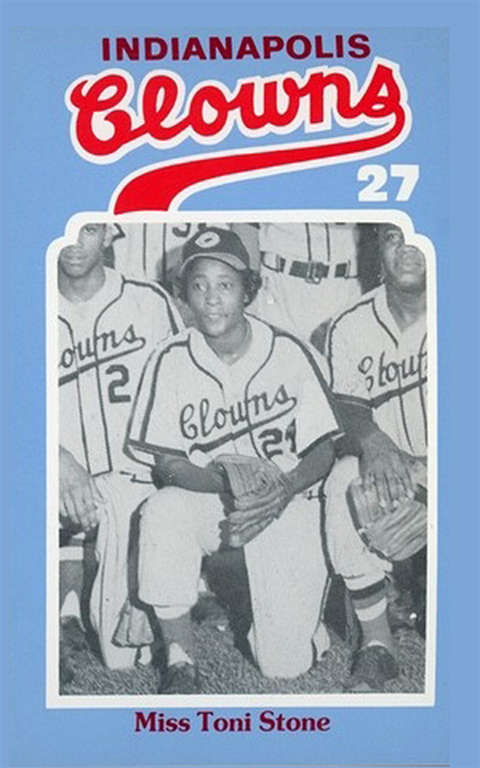
The 1976 Laughlin Indianapolis Clowns Toni Stone card is a retrospective collectible honoring one of baseball's most groundbreaking figures. Featured in the 1976 Laughlin set commemorating the legendary Negro League team, this card depicts Toni Stone, the first woman of any race to play professional baseball as a regular player on a major men's team in the United States. Stone joined the Indianapolis Clowns in 1953 as a second baseman, filling the position vacated by Hank Aaron, who had just signed with the Milwaukee Braves. This card stands as the first widely distributed collectible honoring Stone's historic achievements in both baseball and women's sports history.
Toni Stone's legacy is monumental: she shattered both gender and racial barriers in professional sports, playing alongside men in the Negro American League at a time when women were entirely excluded from professional baseball. Her courage, skill, and persistence opened doors and changed perceptions, making her an icon for women's sports and civil rights. The 1976 Laughlin card was one of the first efforts to preserve and celebrate the legacy of the Negro Leagues and its stars—and Stone's inclusion was a powerful acknowledgment of women's contributions to the sport. The card remains highly collectible and culturally significant as a rare artifact documenting women's professional sports history and Black baseball heritage.

This is the first and only mainstream-era playing-days card of Earl Lloyd, featured in the 1957 Topps basketball set. Lloyd made history on October 31, 1950, by becoming the first Black player to appear in an NBA game, debuting for the Washington Capitols just three years after Jackie Robinson integrated Major League Baseball. Lloyd’s presence on the court marked the official racial integration of the NBA, opening doors for other Black pioneers such as Chuck Cooper and Nat “Sweetwater” Clifton, who also entered the league in 1950. Over a nine-year career, Lloyd contributed as a defensive stalwart and later became one of the NBA’s first Black assistant and head coaches.
Lloyd’s milestone came in an era of modest public attention compared to Robinson’s, but his impact on the league’s evolution is profound. Along with Cooper and Clifton, Lloyd helped forge the path for generations of Black athletes in professional basketball. He and Jim Tucker were also the first Black players to win an NBA championship (with the Syracuse Nationals in 1955). Lloyd’s courage, dignity, and perseverance helped change the NBA forever and are symbolized by this vintage rookie card—now a valued artifact for collectors and historians.

The 1948 Leaf Kenny Washington rookie card (#17) commemorates the man widely regarded as the “Jackie Robinson of the NFL.” Washington famously broke the NFL’s modern-era color barrier when he signed with the Los Angeles Rams in 1946. This historic milestone came one year before Jackie Robinson integrated Major League Baseball and three years before Wally Triplett became the first Black player drafted and to play in an NFL game in 1949. Washington’s NFL debut ended a 12-year league ban on Black players and helped usher in a new era of integration in professional football.
This rookie card is a touchstone of both sports history and the football card hobby. Washington’s career paved the way for generations of Black athletes in the NFL. His pioneering resilience in the face of discrimination paralleled Jackie Robinson’s legacy in baseball, and his importance is underscored by his key role alongside teammate Woody Strode in reintegrating the sport. The 1948 Leaf football set is also considered a landmark release, making this card especially coveted by collectors and historians interested in racial progress and gridiron greatness.