Posters
Find movie posters, concert bills, and advertisements from Black cultural history.

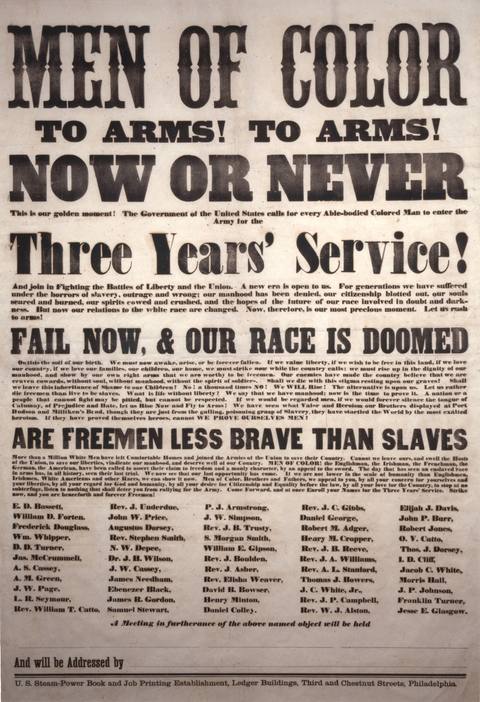
The “Men of Color, To Arms! Now or Never!” broadside is one of the most powerful recruitment posters produced during the American Civil War. Printed in Philadelphia in 1863, the poster called upon African American men to enlist in the Union Army following the issuance of the Emancipation Proclamation earlier that year. Written in bold, urgent language, the broadside appeals directly to Black men to seize what it describes as their “golden moment” to fight for liberty, citizenship, and the future of their race. The document emphasizes the opportunity for formerly enslaved and free Black men to prove their bravery and patriotism by joining the struggle against slavery. Its dramatic typography and powerful rhetoric made it one of the most compelling recruitment appeals of the Civil War era.
The broadside reflects the historic moment when African Americans were officially allowed to enlist in the Union Army, leading to the creation of the United States Colored Troops (USCT). More than 180,000 Black soldiers ultimately served in the Union forces, playing a decisive role in the Union’s victory and the eventual abolition of slavery. Frederick Douglass was one of the most influential advocates encouraging Black men to enlist, believing that military service would strengthen the claim to full citizenship and equality. Two of Douglass’s sons, Lewis Douglass and Charles Douglass, were among the first to enlist in the famous 54th Massachusetts Infantry Regiment. Recruitment broadsides like this one helped mobilize Black communities across the North and became powerful symbols of the fight for freedom and civil rights.

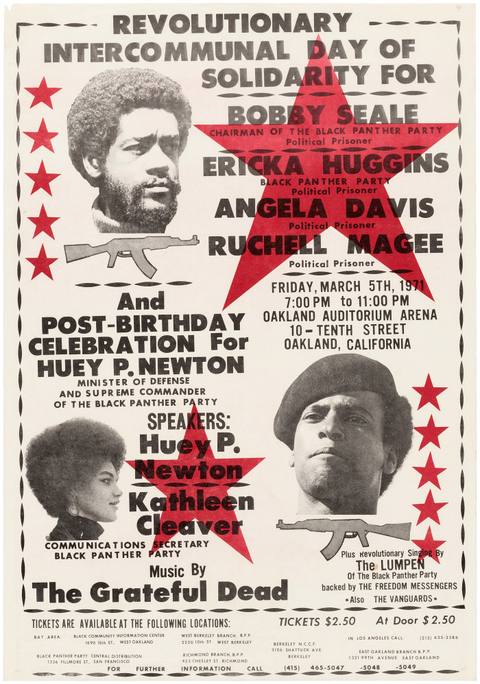
This poster was created for the historic “Revolutionary Intercommunal Day of Solidarity” organized by the Black Panther Party on March 5, 1971, at the Oakland Auditorium Arena. Designed with bold red stars, striking images of party leaders, and distinctive Black Panther graphics, it announced a night honoring political prisoners such as Bobby Seale, Ericka Huggins, Angela Davis, and Ruchell Magee, as well as a post-birthday celebration for Huey P. Newton. The event featured speeches by Black Panther luminaries including Newton and Kathleen Cleaver, along with a rare live performance by the Grateful Dead, symbolizing an extraordinary fusion of Black Power, grassroots politics, and countercultural music. The poster’s powerful design has made it an enduring visual icon of the Black Panther era.
This piece stands among the ultimate cultural “grails” of Black activist memorabilia. It encapsulates the crosscurrents of liberation, solidarity, and creative expression that defined the Bay Area in the early 1970s and is revered both as a Black Power visual masterpiece and as a rare artifact of music history. Produced during the peak of the Panthers’ influence and the Grateful Dead’s social reach, the poster’s scarce survival and strong demand among collectors highlight its lasting significance, bridging movements, generations, and political identities. Its vivid graphics and roster of legendary names make it a centerpiece for collections focused on Black activism, American protest history, and the visual legacy of resistance.

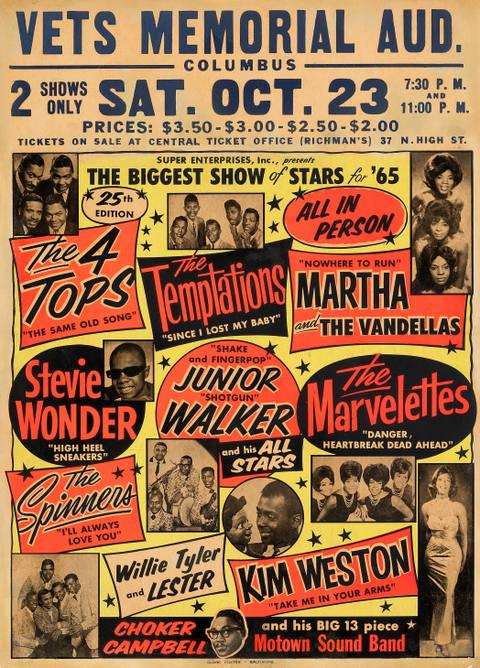
This is an original, larger-than-life concert window card (22" x 30.5") for the "Biggest Show of Stars for '65" presented by the Motortown Revue at Columbus, Ohio’s Vets Memorial Auditorium, October 23, 1965. Designed by Globe Poster, the Day-Glo card features vivid images and names of Motown superstars: The Temptations, The 4 Tops, Martha and the Vandellas, The Marvelettes, The Spinners, Stevie Wonder, Junior Walker & The All-Stars, Kim Weston, Willie Tyler & Lester, and Choker Campbell’s Motown Sound Band. This card captures an era-defining lineup for two sold-out shows, celebrating artists with over 100 Top 20 hits among them and chart-topping influence across American popular music.
As the only known example from this legendary Motown tour, this poster represents the pinnacle of R&B concert memorabilia and the national power of Motown's touring "revue" format. The 1960s Motown Revue broke entertainment barriers by taking integrated lineups of Black recording artists to major venues nationwide, broadening both Black representation and mainstream acceptance on a scale never seen before.

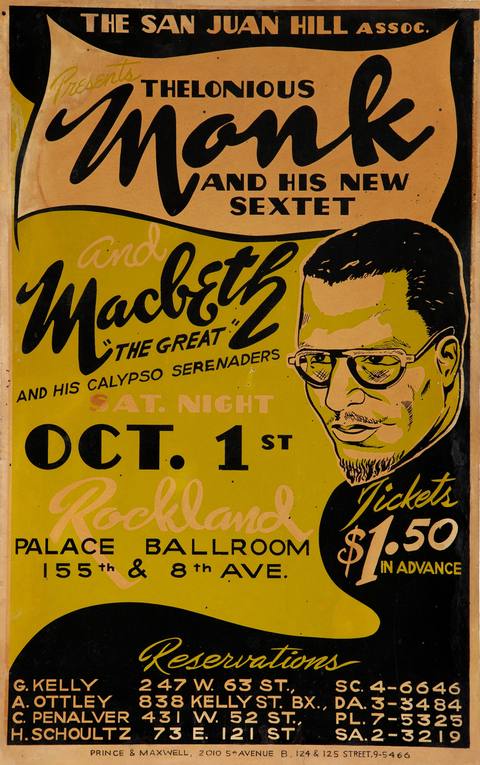
This original window card advertised Thelonious Monk and his New Sextet performing at the Rockland Palace Ballroom in Harlem on October 1, 1949. Printed locally by Prince & Maxwell, it features mint-green coloring, bold fonts, and a stylized drawing of Monk, reflecting the spirit of Harlem’s small but vibrant jazz community. The period detail, including listing of ticket reservation addresses, places viewers directly in the scene of postwar Harlem, during Monk’s legendary tenure as a Blue Note bandleader.
Post-WWII jazz concert posters for Black musicians are exceptionally rare, and this piece documents Monk at the height of his creative powers during the golden age of bebop. Monk’s innovations redefined jazz composition and performance, and his role in Harlem elevated him as a national icon and second most recorded jazz composer after Duke Ellington. The poster serves as a true relic of Harlem’s artistic renaissance and the intimate world of jazz clubs at mid-century.

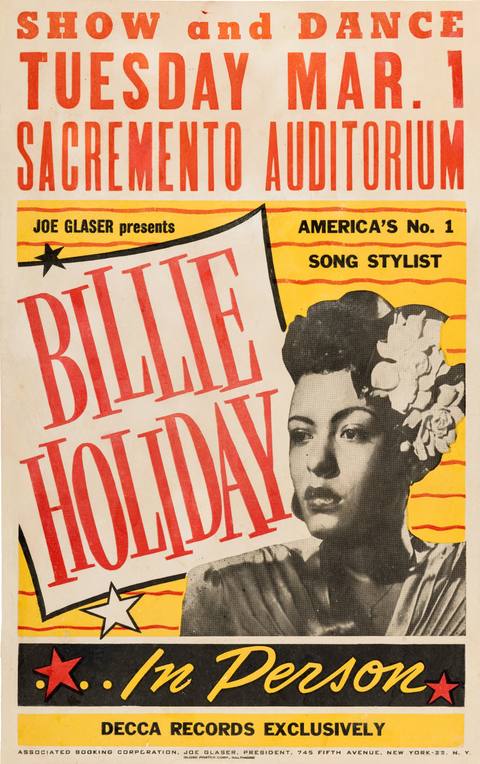
This original 14 x 22 inch cardboard window card poster advertised Billie Holiday’s “Show and Dance” performance in Sacramento, California, on March 1, 1949. Created by the renowned Globe Poster Corp. of Baltimore, the piece features a captivating portrait of Holiday with her trademark white gardenias and striking type treatment. Designed as a reusable tour blank, it boasts vibrant colors, detailed graphic flourishes, and a unique misspelling of Sacramento. Unlike her New York or East Coast posters, this was made for touring and is the only known surviving example of its kind, endorsed with “America’s No. 1 Song Stylist”.
The poster stands as a rare visual artifact from the height of Billie Holiday’s career, capturing her legendary status and her tours outside New York. Its design excellence and association with Joe Glaser’s management reflect the era’s innovation in entertainment marketing. This is a trophy piece in American jazz, blues, and pop history, highlighting a year when Holiday recorded key classics and directly connected with West Coast audiences. With only about six surviving specimens, it serves as a cherished testament to “Lady Day’s” enduring legacy.