1972
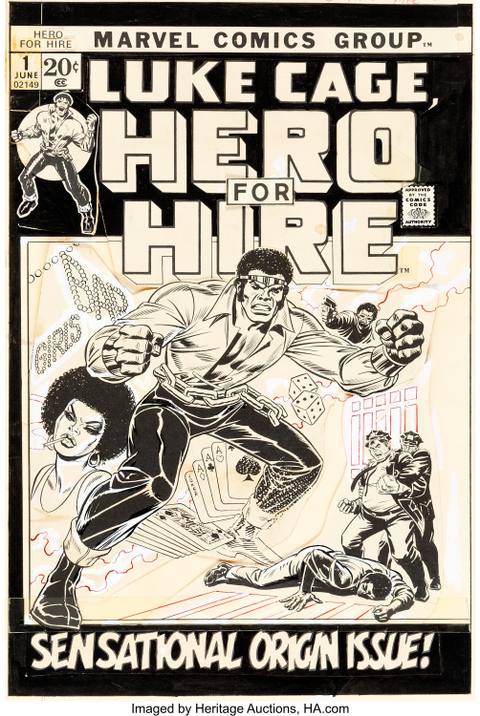
John Romita Sr. Hero for Hire #1 Cover Original Art
This is the original cover art for "Hero for Hire" #1, which marks the debut of Luke Cage, Marvel’s first Black superhero to star in his ow…
94Legendary

From Slavery Through Reconstruction (1934) is one of four large murals in Aaron Douglas’s Aspects of Negro Life series, painted for the 135th Street Branch of the New York Public Library in Harlem. The composition unfolds in overlapping, silhouetted figures arranged in circular bands of light, using Douglas’s signature flat shapes, sharp diagonals, and limited palette of violets, greens, and yellows to create a cinematic sense of movement through time. In the left foreground, enslaved figures labor under the watch of an overseer and a billowing Confederate flag, while a central, radiant zone shows a man pointing toward the future as newly freed people gather around him. On the right, a group of Black citizens stands before the U.S. Capitol dome and ballot box, suggesting the fragile promises of freedom, voting rights, and citizenship after the Civil War. The entire scene is unified by rhythmic beams of light that move from darkness to brightness, visually narrating a journey from bondage toward hope and political participation.
This mural is a cornerstone of Harlem Renaissance visual culture and one of the most ambitious attempts of the era to compress African American history into a single, modernist image cycle. By fusing African-inspired silhouettes, Art Deco geometry, and mural-scale storytelling, Douglas created a new visual language that aligned with contemporary Black writers, musicians, and intellectuals who were reimagining Black identity on their own terms. From Slavery Through Reconstruction is especially significant for the way it links slavery, emancipation, and Reconstruction as part of a continuous, unfinished struggle, rather than isolated episodes; the hopeful rays of light and the pointing figure acknowledge progress while hinting at the obstacles that would follow. Commissioned during the New Deal period, the mural also testifies to how Black artists used public art programs to insert Black history and aspirations into civic spaces that had long excluded them.
Validate this item’s Black Grail Score with verified heritage data
Heritage verification opening soon
1972
This is the original cover art for "Hero for Hire" #1, which marks the debut of Luke Cage, Marvel’s first Black superhero to star in his ow…
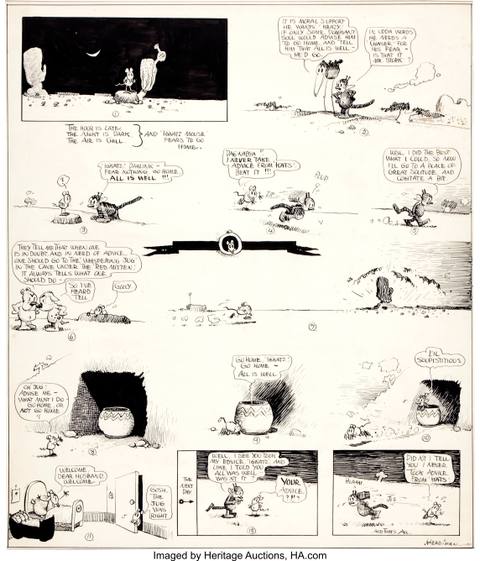
1918
This original Sunday comic strip artwork by George Herriman, dated June 23, 1918, showcases the classic trio of Krazy Kat, Ignatz Mouse, an…
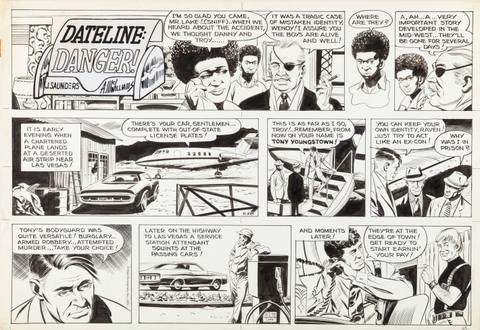 Black Grail Collection
1970
"Dateline: Danger!" Daily Comic Strips Original Art consists of the hand-drawn, published daily newspaper strip panels from the groundbreak…
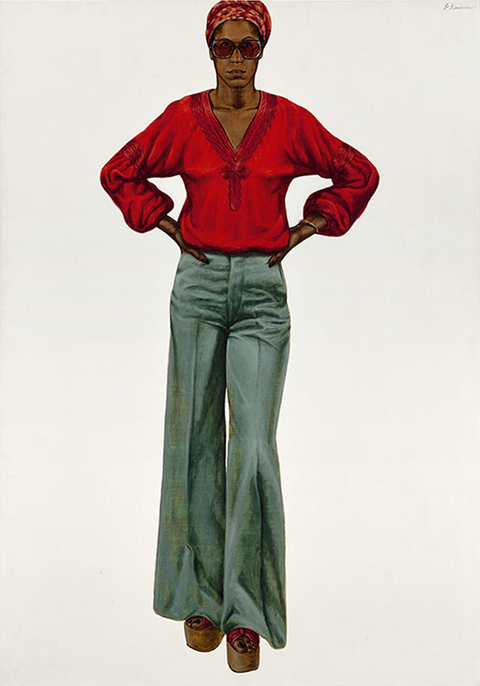
1974
"Brenda P" is a commanding portrait by Barkley L. Hendricks, completed in 1974 using oil and acrylic on canvas. Measuring 72 by 50 inches,…